
Outdoor squash court vs indoor - which is right for your club?
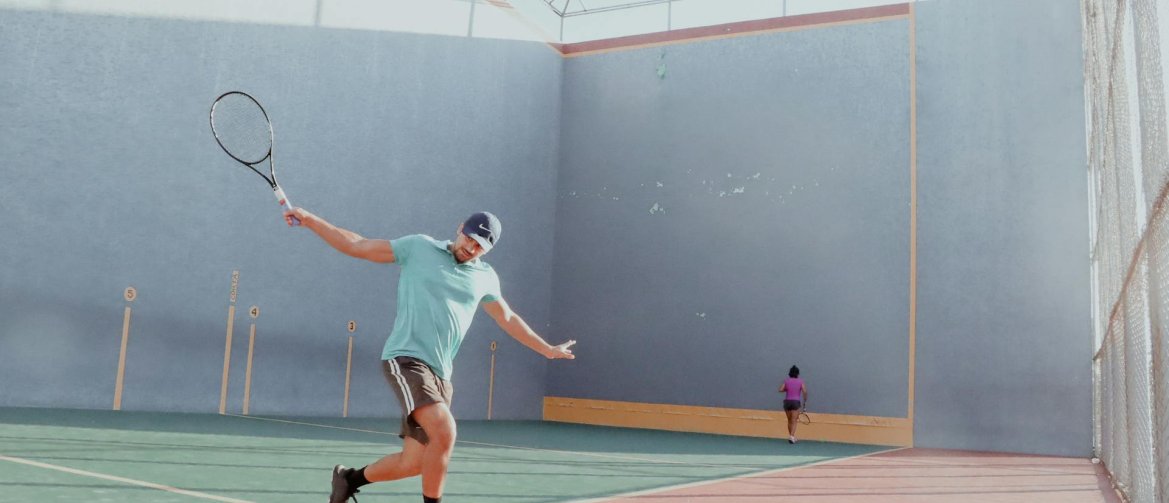
The PSA Foundation surveyed 1,012 squash players across 65 countries and found that 83% believe outdoor squash courts would help grow club membership. At the same time, UK participation has fallen to roughly 250,000 adults in 2023, down from 425,600 in 2016. Clubs face a real decision: keep investing in traditional indoor space, or bet on an outdoor court to pull in new players before the LA28 Olympic bump arrives.
This guide compares outdoor and indoor squash courts across the factors that actually decide the call, construction and capex, weather and utilisation, maintenance, visibility, and commercial upside. No marketing fluff, just what a club operator needs to weigh before signing a contract.
What counts as an outdoor squash court?
An outdoor squash court is a free-standing squash installation designed to withstand rain, UV, temperature swings, and public exposure, while still conforming to WSF court dimensions. It is not a traditional indoor court with the roof removed.
Two formats dominate the market in 2026:
- Glass court outdoors. Essentially the ASB ShowGlassCourt concept adapted for permanent outdoor use. All four walls are toughened safety glass, floor is typically timber panels for private setups or weather resistant plastic for public ones.
- HPL steel frame court. The ASB OutdoorSquashCourt uses a steel frame with specially designed HPL (High Pressure Laminate) board walls and sports floor tiles with resistant paint for line markings. According to ASB, the court is weather resistant even in hurricane conditions and can be dismantled and relocated.
Both formats measure the WSF singles standard of 9.75 m long and 6.4 m wide. Both require a flat area of roughly 12 m by 10 m (minimum), usually on concrete, and both can be fitted with optional lighting rigs for evening play and optional roofs for year round use.
The distinction matters because it changes your utilisation assumptions. A glass court on a hotel terrace in Marbella is a different business than a public HPL court in a Manchester park.
How does an outdoor court compare to a traditional indoor court?
The short answer: outdoor wins on visibility, footfall and brand impact; indoor wins on climate control, hours of play and booking predictability. Below is a direct comparison on the factors that drive the decision.
| Factor | Outdoor court (glass / HPL) | Indoor court (WSF standard) |
|---|---|---|
| Court dimensions | WSF 9.75 m x 6.4 m | WSF 9.75 m x 6.4 m |
| Space footprint | 12 m x 10 m minimum, freestanding | Depends on building shell, usually inside existing leisure facility |
| Playable hours per year (UK climate) | Approx. 1,000 to 1,800 without roof, up to 3,000+ with roof | 4,000+ (limited mainly by opening hours) |
| Weather dependence | High without roof, low with roof and lighting | None |
| Public visibility | Very high, acts as marketing asset | Low, hidden behind changing rooms |
| Maintenance | Cleaning, occasional panel checks, drainage upkeep | Plaster wall refinishing every 5 to 10 years, floor sanding |
| Ball speed perception | Slightly different due to temperature variance and open air | WSF reference conditions |
| Spectator capacity | High, no walls to block view | Limited by gallery size |
| Suitable for tournaments | Yes (has hosted PSA events on cruise ships and in public squares) | Yes |
| Relocatable | Yes, modular systems can be dismantled | No |
| Typical primary use | Public engagement, demo days, hotel/resort amenity, urban regeneration | Club membership, league play, coaching |
Construction and capital cost
Outdoor courts cost more per unit than indoor courts, but they avoid the cost of a building shell. An indoor squash court inside an existing leisure centre comes in relatively cheap because the walls, roof and foundations already exist. Building a new indoor court facility from scratch is a different conversation, that involves a full construction budget including planning, foundations, mechanical ventilation, and changing rooms.
The cost variables to pin down before you talk to a supplier:
- Foundation and groundworks. Outdoor courts need a flat concrete pad of at least 12 m by 10 m. If you already have suitable ground, this is a small item. If you are pouring a new slab in central London, it dominates the budget.
- Walls. Glass walls are premium, HPL board walls are the more affordable outdoor option. Both are engineered for ball speeds that can reach 200 km/h.
- Floor. Outdoor options include weather resistant plastic boards on an elastic drainage substructure (the ASB approach), which lets the court be played on almost immediately after rain stops.
- Lighting. Outdoor lighting rigs cost extra but unlock evening utilisation. WSF specifies a minimum of 300 lux at 1 m above floor level, most serious installations go well above that.
- Optional roof. The single biggest decision for climates like the UK, Poland or Germany. A roof roughly doubles your annual playable hours but adds significantly to cost.
- Planning permission. In the UK and most of Europe this is non-trivial for a visible outdoor structure. Factor in several months and local authority fees.
Ask each supplier for a fully specified quote including groundworks, delivery, installation, lighting, and one year of maintenance, otherwise the numbers are not comparable.
Weather, climate and utilisation: the real UK and European question
A Northern European club does not get the same return on an outdoor court as a resort in Dubai or a club in Sydney. The question is how many extra playable hours the outdoor court actually delivers, and whether those hours fall when members want to play.
Rough planning assumptions for the UK and Central Europe:
- Without roof, without lighting. Useful for daylight hours between April and October. Realistic utilisation is perhaps 30 to 40% of the year, mostly evenings in summer and weekends in shoulder seasons. Expect strong novelty demand in year one, moderate demand after.
- Without roof, with lighting. Adds summer evenings and stretches shoulder seasons. Winter use is limited to mild, dry days.
- With roof and lighting. Extends utilisation year round. Wind driven rain still bothers glass courts with partial roofs. Temperature inside the court can drop well below indoor norms, ball behaviour changes.
Scottish, Irish and Scandinavian clubs face the steepest utilisation risk. Southern European, Middle Eastern, Indian and Australian clubs face far more favourable economics. For Poland, a mid climate country, the realistic use case is a seasonal summer court with good lighting, treated as a marketing and recruitment asset rather than the primary booking engine.
Why clubs are building outdoor courts now?
Three pressures converge in 2026:
- Participation decline in traditional markets. Sport England data shows the number of adults playing squash in England fell from 294,200 in 2018 to 264,100 in 2022, and down to around 250,000 in 2023. Occasional participants (once or more per year) dropped from 1,056,300 to 773,300, a 27% fall. Clubs need new acquisition channels.
- The LA28 Olympic opportunity. Squash makes its Olympic debut at Los Angeles 2028, staged at Universal Studios. China reported over 30% growth in clubs and participation after the IOC decision. UK and European clubs have a narrow window to capitalise on the attention.
- Proof that outdoor works as a growth tool. The Maspeth outdoor court in Queens, New York has hosted visits from Mohamed ElShorbagy, Joelle King, Joshna Chinappa and Saurav Ghosal, and regulars including England's Nathan Lake (world No. 37). PSA Foundation research found 83% of 1,012 surveyed players believe outdoor courts would help grow club membership.
Is squash still declining in the UK?
Yes, but the rate is slowing and Olympic inclusion is changing the sentiment. Sport England recorded a 4% year on year decline before the pandemic. The 2021 to 2022 data shows a 10% drop over three years, a smaller annualised rate. England Squash now reports more than 200,000 people playing weekly at 1,500+ venues. The sport is smaller than in the 1980s peak of around three million UK players, but infrastructure investment has restarted around the Olympic narrative.
Maintenance, durability and hidden running costs
Outdoor courts look low maintenance on paper. In practice, the running cost profile is different from indoor, not necessarily lower.
What to budget for on an outdoor court:
- Daily cleaning of glass or HPL walls, especially after rain or dust events
- Periodic inspection of the steel frame and fixings (salt air, UV, freeze-thaw)
- Drainage system upkeep (leaves, silt)
- Lighting maintenance and bulb replacement
- Line marking re-paint on plastic floor tiles every few seasons
- Security, for publicly accessible courts vandalism is a real risk
What you avoid compared to a traditional plaster walled indoor court:
- Annual plaster wall decay and refinishing, which ASB cites as a major issue for centre owners
- Court downtime during refinishing
- Mechanical ventilation and air handling
- Heating costs in winter (though lighting costs partly offset this)
Glass walled outdoor courts have a specific advantage. As ASB notes, glass is not subject to damage through humidity, heat or cold, and can be installed in any environment with minimal maintenance beyond cleaning. That changes the long term economic picture for clubs willing to pay the glass premium upfront.
Revenue model: how outdoor changes the commercial case
An indoor court in a traditional club earns revenue from member bookings, coaching, and pay and play. An outdoor court can earn from the same streams, plus a set of commercial opportunities that indoor courts cannot offer:
- Event hire. Corporate tournaments, brand activations, charity events. Outdoor glass courts have hosted PSA level professional events.
- Advertising. Glass and HPL walls can carry branded graphics visible to passers by, a meaningful advertising surface in urban locations.
- School and community programmes. Public visibility makes outreach easier and can attract local authority co-funding.
- Hotel and resort amenity. For hospitality operators, an outdoor court is a differentiator that sits alongside the pool and tennis courts, not behind a locked door.
- Member acquisition funnel. The argument behind the 83% PSA Foundation survey figure. People who would never walk into a traditional squash club will try a free 20 minute session on a court they can see from the street.
The trap is assuming outdoor revenue replaces indoor revenue. In UK and Central European climates it does not. Outdoor complements indoor capacity; it rarely substitutes for it outside resort locations.
Which court is right for your club?
The answer depends on what you are actually trying to fix. Use the shortcuts below to match your situation to the likely best option.
- Existing UK or Polish club with falling membership, modest budget. Refurbish or install a second indoor court first. Only add outdoor if you have street visibility that would justify it as a marketing asset.
- Club with strong membership, pressure on court availability. Second indoor court is usually the better yield per pound invested.
- New facility being built from scratch in a warm climate. Seriously consider outdoor as the primary court, with one indoor backup.
- Hotel, resort or premium leisure development. Outdoor glass court as amenity is the obvious choice. The marketing and photography value alone can justify it.
- Public facility, local authority, school. HPL outdoor court with optional roof is designed for this use case. Lower unit cost, robust against public exposure.
- Club preparing for LA28 growth wave. A combination: keep your indoor courts sharp, add a single outdoor glass court as a visibility and recruitment asset. The court does not need to carry the booking load, it needs to put squash in front of people who do not know it exists.
FAQ
Do outdoor squash courts meet WSF specifications?
Yes, when built by accredited manufacturers. WSF specifies court dimensions (9.75 m x 6.4 m for singles), wall heights, line markings and floor properties. Outdoor courts from accredited suppliers such as ASB meet the same dimensional and material standards, with additional engineering for weather exposure. WSF's Full Court Specification is the reference document architects and builders work from. The federation also runs an accreditation programme for courts and equipment.
Can you play squash outdoors in winter in the UK or Poland?
With a roof and lighting, yes. Without a roof, realistically no. Cold temperatures change ball behaviour noticeably, squash balls rely on heat to bounce properly, and wet or frozen floors are unsafe. Roofed outdoor courts extend winter play but may still see reduced bookings in sustained bad weather compared to fully enclosed indoor space.
How much space does an outdoor squash court need?
A minimum flat area of 12 m x 10 m, preferably concrete. The court itself is 9.75 m x 6.4 m but you need margin for the structural frame, access doors and surrounds. If you plan spectator space, event hosting or a clubhouse extension, allow more.
Do outdoor courts need planning permission?
In most UK and European jurisdictions, yes. An outdoor court is a permanent or semi-permanent structure with visible walls (often 5.5 m+ high to meet WSF clear space requirements). Treat it as you would treat any sports facility construction, factor in 3 to 9 months for approvals depending on location.
How long does installation take?
Modular systems from ASB and comparable manufacturers can be installed in days to a few weeks once the concrete slab is ready. The critical path items are groundworks and planning permission, not court assembly. Glass courts are designed for fast, clean installation with no dust in the surrounding facility.
Will an outdoor court actually attract new members?
The data is encouraging but not guaranteed. 83% of PSA Foundation survey respondents across 65 countries said outdoor courts would help grow club membership. The Maspeth court in Queens has drawn world class players and regular recreational users. What outdoor courts do reliably is increase visibility, the commercial conversion rate from visibility to paying members depends on how the club follows up with programming, coaching and entry level offers.
Is the ball speed or play experience different outdoors?
Subtly yes. Temperature variance affects ball bounce, outdoor lighting casts different shadow patterns than indoor lamps, and the absence of a ceiling changes the audio feedback players rely on. Serious players adapt within a session. For recreational players and first time users, the differences are negligible.
Vide!
Garden Lights - How To Choose The Best Ones?
Choosing the right outdoor lights is serious business - not only should it illuminate your house...

Underestimated compensation from the civil...
A car accident in itself is a very unpleasant event, but unpleasant situations do not end there. If...

How much can you earn while working on the...
Working from home or elsewhere on the internet has become one of the most popular types of work...


